Deprecated: Function create_function() is deprecated in /home/villahuq/public_html/wp-content/plugins/wp-tradingview/inc/class_profile.php on line 178

Deprecated: Function create_function() is deprecated in /home/villahuq/public_html/wp-content/plugins/wp-tradingview/inc/class_ideastream.php on line 289

Deprecated: Function create_function() is deprecated in /home/villahuq/public_html/wp-content/plugins/wp-tradingview/inc/class_ideaview.php on line 155

Deprecated: Function create_function() is deprecated in /home/villahuq/public_html/wp-content/plugins/wp-tradingview/inc/class_chat.php on line 216

Deprecated: Function create_function() is deprecated in /home/villahuq/public_html/wp-content/plugins/wp-tradingview/inc/class_chart.php on line 444

Warning: Cannot modify header information - headers already sent by (output started at /home/villahuq/public_html/wp-content/plugins/wp-tradingview/inc/class_profile.php:178) in /home/villahuq/public_html/wp-includes/feed-rss2.php on line 8
Blog – Village Trader https://villagetrader.co.za Village Trader staging Wed, 16 Mar 2022 03:26:30 +0000 en-US hourly 1 https://wordpress.org/?v=6.2.9 The end goal https://villagetrader.co.za/2022/03/16/the-end-goal/?utm_source=rss&utm_medium=rss&utm_campaign=the-end-goal https://villagetrader.co.za/2022/03/16/the-end-goal/#respond Wed, 16 Mar 2022 03:26:27 +0000 https://villagetrader.co.za/?p=3341 The end goal Read More »

]]>
I have been thinking a lot about my purpose in trading and investing lately.

I started trading a small account on the JSE in 2003. In 2011 I opened an offshore account. I have always had an absolute fascination with markets and a desire to try and work them out. This of course will never happen and even the brightest minds have blown up accounts and left the markets. However, back then, besides my fascination, I guess deep down, my idea was to have a side hustle that could spin off some cash so that I could escape the corporate march someday. That was always my aspiration as a young and free 20-something-year-old. Now, almost 20 years on, I have a wife and two sporty young bright boys. I have just left the corporate world after 6 years at Unilever and 15 years at SAB-Miller / AB-InBev. I work in a smaller organisation with exciting growth prospects but of late I have been thinking a lot about time and purpose.

The late Van K. Tharp, who recently passed said the following on episode 76 of Steven Goldstein and Mark Randall’s The Alphamind Podcast:

If you could have anything in the world, what would it be?

They might say: “I want $1 000 000”.

If you then asked them, “If you had that, what would it get you?”

They might then say: “I would be able to buy this, this and this.”

If you then asked them: “What would that get you?”

They may say: “I’d feel more secure.”

If you challenge them further and ask them what security would get them, they could say something like: “I’d feel more peaceful and happier.”

What if you could get peaceful and happy first?

Back in my 20’s it was all about a dreamier future. In mid-life, my wife and I find ourselves searching for a larger home so our boys can live out the rest of their school years. After that, they will be gone, and so will the school fees, and the nest will be empty and I will be in the next stage of my life. So, what am I actually saving for?

In 2018, Tom Canfield, a trader of 20 years, lost $500k in 1hr. It took him 18 months to make the money back and 3 years on, as he relayed the story on The Alphamind Podcast (Episode 62), the emotions were still stirred up. He returned to the podcast a year later (Episode 84) after having had a heart attack. On this podcast he spoke about how he didn’t realise how much of a toll full-time trading had taken on him. He was also always chasing some dream of a ski house in Aspen where he and his wife and kids could live someday. As the kids grew up and left home (and the private school fees and sports clinic fees lifted), he let go of this dream and bought in a new state closer to his kids. He is much more fulfilled, peaceful and happy.

Turney Duff worked on Wall Street and was enormously successful. Unfortunately, he got hopelessly addicted to cocaine and his career eventually came crashing down as he lived the high life on Wall Street. He wrote a book telling his story: The Buy Side: A Wall Street Trader’s Tale of Spectacular Excess. Now divorced, as he relayed his story to Aaron Fifield (Chat With Traders, Episode 106), he stated that he went from being a guy who wanted to live the good life to a guy that wanted to live a good life. He states that when he made this shift, that’s when it all clicked for him. He now lives in Long Island, 40 miles outside of the city and 2 miles from his daughter. He writes and has a simple life, paying $1300 a month for rent, barely gets by and just tries to be a good father. He then goes on to state that he has never been happier!

I think it really is dependent on where you are in your life but my message to you is: know your purpose as a trader or investor. Is it to teach? Is it to raise cash to help Ukraine? Is it to feed your ego? Is it to gain some validation on Twitter? Is it to get filthy rich? If so, what will you do then? Know yourself and know your purpose, first and foremost. Don’t postpone contentment. Be obsessed about markets but have balance outside of that. Live each moment in life and try to do something good for others. Life is short.

]]>
https://villagetrader.co.za/2022/03/16/the-end-goal/feed/ 0
Forget the scoreboard https://villagetrader.co.za/2021/09/06/forget-the-scoreboard/?utm_source=rss&utm_medium=rss&utm_campaign=forget-the-scoreboard https://villagetrader.co.za/2021/09/06/forget-the-scoreboard/#respond Mon, 06 Sep 2021 21:09:34 +0000 https://villagetrader.co.za/?p=2661 Forget the scoreboard Read More »

]]>
You are not your score board. As traders our scoreboard is the balance and equity are our scoreboard, and it doesn’t lie. It’s either going up, down or staying the same. While profit and losses are a great measure of profitability. They are a terrible measure of progress or lack thereof. If you measure your progress by whether or not your last trade was profitable or not.

This end goal oriented approach for measuring progress is flawed for one simple reason. When it comes to the outcome of any random trade you have zero control of whether the trade ends up profitable or not. Randomness and luck get to play that role. We have to measure our progress and the area of focus should be on what we do, not how we are doing at least on a trade by trade basis. In fact it actually doesn’t matter how the results of a trade turn out as. What matters is if we executed our plan. We need to observe and analyse results with detachment and nonjudgement. Learn what needs to be learned if any and move on. The result of the trade doesn’t tick your progress scale one way or the other. They certainly don’t define you either. You are not your results.

Your long term goal about the money you desire should only serve as a router. Guiding you along the way. Our main focus and goal should be the process of getting there.

Let’s say you have a reasonable goal of making a R1 million from trading in 5 years. Once you have that goal in mind. Use some imagination for a second and pretend it’s now 5 years later and now you’ve made your million. Ask yourself how you make that million. What did you do or not do, how did you grow your account, what was your approach, how did you handle risk management, try to throw in as much detail as you can. It’s okay to make some stuff up after all that’s what imagination is. It’s also okay if you don’t know how to get or do some of the stuff you write down.

Then look at the things you do, and pick the ones that you can achieve, the smaller the better. That with the resources and knowledge you have right now you can achieve, and make those your goal. If you do these things as your goal. Work toward just achieving those “small” things on the list. Make those your goal, because you know these are the things that bring me closer to my longer term goal. Most importantly, it helps build up the momentum and the feeling of winning and moving forward. It also puts your progress well within your control. You keep getting the positive feedback loop from achieving.

If we instead just look at the million is the only goal. If it takes 5 years to get there. We are going to spend 5 years without achieving any goal. For every second your account is not a million rands you haven’t achieved a goal. Another question comes, after 5 years and a million then what?

Once you have your goal, shelve it, start the process of getting closer toward it, trust yourself, your abilities and go for it with unconditional confidence and an unshaken belief.

Remember things change when you change

]]>
https://villagetrader.co.za/2021/09/06/forget-the-scoreboard/feed/ 0
The discipline meath https://villagetrader.co.za/2021/08/18/the-discipline-meath/?utm_source=rss&utm_medium=rss&utm_campaign=the-discipline-meath https://villagetrader.co.za/2021/08/18/the-discipline-meath/#respond Wed, 18 Aug 2021 19:15:38 +0000 https://villagetrader.co.za/?p=2543 The discipline meath Read More »

]]>
Discipline is one of the most important skills one needs on their journey to being a successful trader in the long run. However, to maintain success and peak performance discipline fades away. Discipline is important in the beginning because it’s where we’re transitioning from one state to the other. Meaning in the beginning we’re faced with plenty of conflicts in our game. Hence we need discipline to do what is best for us and our performance. We have the edge to do something else other than what we have to do. Like the edge of letting a loss run for another tick or two in hopes that it turns back in our favour. At that point we need discipline to cut the loss short. Because we truly would rather not take the loss

In studying and chatting to successful traders and analysing the difference in my own performance, analysis and trade execution. What others perceive is enormous discipline is really a natural extension of who they are. They don’t need discipline to do the right thing because they have no conflicts in their minds. For example cutting a loss short is a natural extension of who they are, there’s nothing else they would rather do. Running a winner requires zero discipline for them because there aren’t any other conflicting thoughts competing with the decision and execution.

This is why it’s essential to put as much if not more in working with your conflicts. Assess their roots, ultimately resolving conflicts at a root level. Because every decision you make in the market is 100% yours. Even if you followed or copied someone. Only you bear the responsibility of the consequence. So the conflicts referred to here are all in your mind all coming from within you. The expression “stuck between minds” should really be “stuck between beliefs”.

To quote Dr. Van K Tharp “We don’t trade the markets, we trade our beliefs about the markets”. Whenever you find yourself with conflicting thoughts in your decision making. It’s really just conflicting beliefs trying to get their way. This means in order to permanently resolve mental conflicts, we need to resolve the conflict between beliefs. While we use discipline in the short term to keep us steering in the direction we wish to go. We need to work toward resolving the conflicts at the belief level. Mindful meditation is one of the tools that could help. Paying attention to our thoughts, actions and emotions in real time

Our beliefs also drive our identity. Perhaps we can use how we identify ourselves as a signal to see how much more work is needed in resolving the conflicts. For example if you’re identifying yourself as someone who’s still trying to be a disciplined trader. Means you would still rather do something else other than what you believe you suppose to do (The right thing). But if you identify yourself as a disciplined trader, and there’s no conflicts when doing what you suppose to do. No discipline is needed because doing the right thing is a natural extension of who you are. Be Careful not to lie to yourself.

Which brings me to the most important part of conflict resolution. Knowing what is the “right thing” Which I believe is the main characteristic that separates winners and losers in our sport. Creating rules that define the “right thing” for you. The very first conflict that needs to be addressed is the conflict between creating rules to guide execution and not creating them. These rules will help you to chip away in the resolution. Until being a disciplined trader is a natural extension of who we are. For without rules everything we do is unintended therefore a mistake. (Please note a loss is NOT a mistake).

RESOLVE THE CONFLICT PROBLEM RESOLVE THE DISCIPLINE PROBLEM

]]>
https://villagetrader.co.za/2021/08/18/the-discipline-meath/feed/ 0
The Hidden Profits https://villagetrader.co.za/2021/08/12/the-hidden-profits/?utm_source=rss&utm_medium=rss&utm_campaign=the-hidden-profits https://villagetrader.co.za/2021/08/12/the-hidden-profits/#respond Thu, 12 Aug 2021 10:59:10 +0000 https://villagetrader.co.za/?p=2489 The Hidden Profits Read More »

]]>
As traders we tend to easily remember all the giant profits trades, everytime our stop was hit and the market turned and ran in our favour without us. We rarely ever remember or talk about the times our stop was hit and the market fell some more.

Trading and investing is really a game of turning cash into an asset (long/short position) then back in cash. We typically look at a trade entered and a trade exit. We are either in a position or not. I say, we’re always in a position, remember cash itself is a position.

We only call it a trade when we turn cash into a position and the end of that trade ends when you turn the position back into cash. If we look at trading this way as a conversion of assets from one kind to another. We can safely say exiting a position is also taking a trade. How? Well let’s look at this concept a bit more.

When I’m going into a stock, I’m also implicitly short cash by the same amount I was long. When I exit the same position at profit or loss. I implicitly long cash and short the stock, even though I didn’t go and take a short trade. In other words I can express a short trade or idea by just staying in cash, meaning I’m short the stock long cash. The further and the longer the stock falls or stays in the range without me. The more profitable that trade is. Why? Because cash earns an interest not by very much but it does, secondly and most importantly the profit I gain is what I call an opportunity gain. Because I’m in cash instead of falling stock I have more in the pocket book and reserved my mental capital for the next opportunity. Being long a falling stock and implicitly short cash. Is a giant opportunity cost, and the market will let you run that bill for as long and as far as you wish.

Let’s look at some examples. I’m going to use my Anheuser-Busch InBev) trade as an example

Trade 1: Long Anheuser-Busch InBev short cash at R1022.24 Exit at R981.01 result R70.09 loss

Trade 2 (The implicit trade) Long cash short Anheuser-Busch InBev at R981.01 result? Let’s look at the chat below
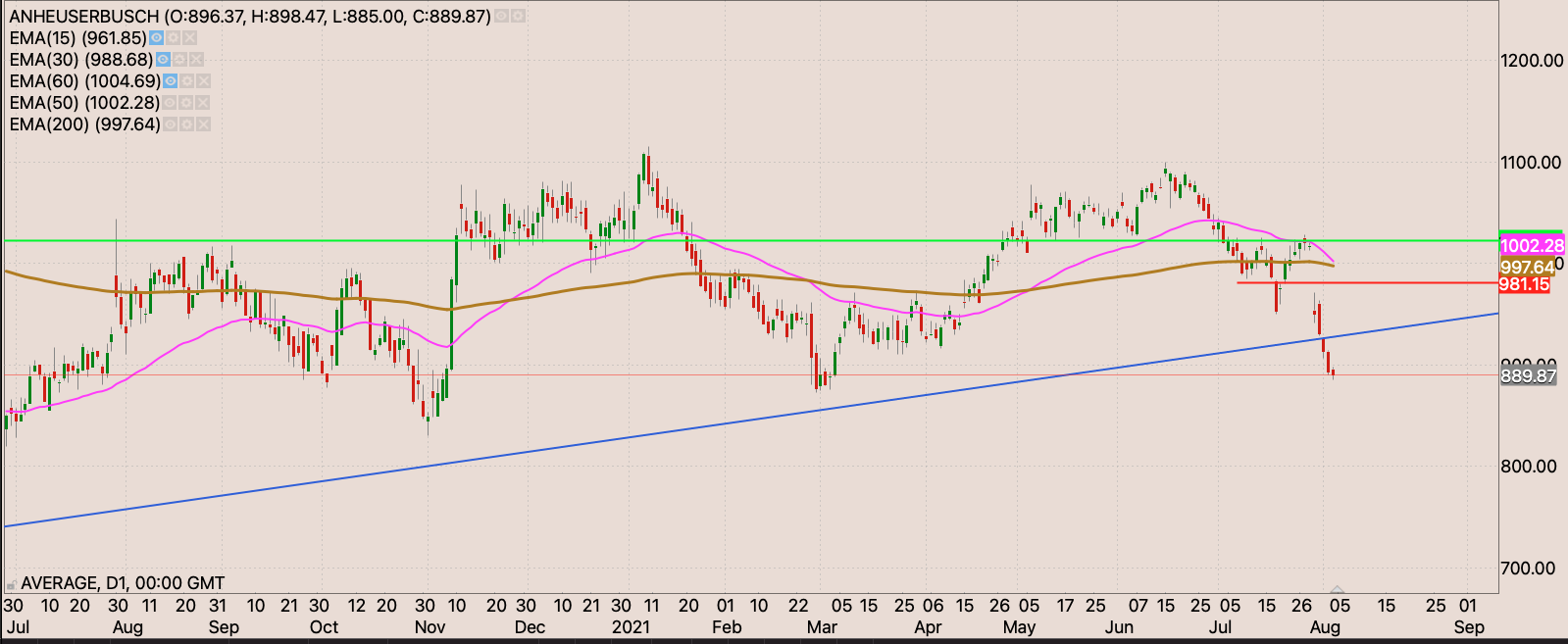
So what is the profit here you ask? Assuming I didn’t take the second trade and exited the position at a small loss. The small R70 loss would have been a R225 loss today as I write after the close 4 August 2021 the stock closed R889.87. A loss 3X bigger. So my profit on the long cash short the stock at R981 is R155 in counting (R225 – R70) 2X the loss on the first explicit trade. That’s the hidden profit no one is talking about. I had no idea the stock would continue to fall. But I didn’t have to lose any more capital to find out if I would recover. Most importantly my account is R155 healthier than it would have been had I stayed with the position for any reason whatsoever. If the stock recovers I will be in a healthy position and take the opportunity. The risk is quite small for the reward.

Thinking of exiting a position especially a losing one as another asymmetric bet. Instead of just taking a loss, and also looking at these hidden profits. It makes it easier to take the loss while it’s still small. The most important rule of survival in the market. CUT YOUR LOSSES SHORT, or rather KEEP YOUR LOSSES SMALL.

]]>
https://villagetrader.co.za/2021/08/12/the-hidden-profits/feed/ 0
The having to make money mindset https://villagetrader.co.za/2021/07/12/the-having-to-make-money-mindset/?utm_source=rss&utm_medium=rss&utm_campaign=the-having-to-make-money-mindset https://villagetrader.co.za/2021/07/12/the-having-to-make-money-mindset/#respond Mon, 12 Jul 2021 19:51:39 +0000 https://villagetrader.co.za/?p=2249 The having to make money mindset Read More »

]]>
You don’t have to do anything in the market. Remember nothing will start till you decide it should, and it goes on for as long as you allow it

Trading from the state of “I have to make money” or worse “I have to make X amount” on a particular trade or over a series of trades will cause us to narrow our focus to that. Instead of being fully aware and being in the present moment. It’ll take us away from the things we need to do in the present moment. Like recognising when it’s time to exit a position because the move is over.

This state of mind can also easily trap us into the mindset of “I know that this trade will be profitable, otherwise why would I put the trade on in the first place”. Causing basic trading errors like not predefining risk, because what’s the point of predefining the risk if we “know” the outcome of the trade before placing it.

Your job as a trader is to recognise what you define as your edge, and execute. Truth is even if you can see your edge in the market. You still don’t HAVE to do anything. Just as when it turns out that the trade is actually a loser, you don’t HAVE to do anything to continue to lose money.

If your focus is too much on the goal. It will inevitably take you from the things you need to do to achieve your goal.

Sure our main objective when placing a trade or just generally as a trader is to make money. But we can’t trade from the state of mind of HAVING to make money. If we do, we’re setting ourselves up for a slap in the face.

Instead we need to be trading for the state of mind of.

“Okay I can see the pattern. This means there’s a good chance this trade will be profitable. But I know that potential will diminish at this price or for these reasons (stop loss, predefining the risk). I’m willing to lose $X to find out if this trade will be profitable (position size). If it works out in my favour, this point or reasons will signal to me the trade is over (profit target). I accept anything that happens after I place the trade including the possibility that I will lose money on this trade, because I know over a good enough sample size I have an edge that puts the odds in my favour. I don’t have to make a certain amount, I will make what I make”

If you HAVE to make $100 what happens if the market only offers you $50? Or if you HAVE to make money what happens when the market offers small losses? Are you going to reject those offers ? Ignoring what the market is telling you because you HAVE to make money or a certain amount? Well, it’s up to you.

You don’t HAVE to do anything and the market doesn’t have to do anything for you. You’re responsible for everything that happens in your trading account

]]>
https://villagetrader.co.za/2021/07/12/the-having-to-make-money-mindset/feed/ 0
The R-multiple https://villagetrader.co.za/2021/07/06/the-r-multiple/?utm_source=rss&utm_medium=rss&utm_campaign=the-r-multiple https://villagetrader.co.za/2021/07/06/the-r-multiple/#respond Tue, 06 Jul 2021 05:24:45 +0000 https://villagetrader.co.za/?p=2216 The R-multiple Read More »

]]>

The most important thing in a bet is it’s R-multiple over a series of similar bets. Your R-multiple determines your margin of error. Margin of error is an amount of errors you can afford, a better way of putting it. It’s the number of losing bets you can afford to take on a series of bets. The R-multiple is directly correlated to the margin of error. The higher the R-multiple. The larger the margin of error. The inverse is true.

R-multiple = average win / average loss

Sidenote: this is how casinos quantify their edge and are profitable as a result. Their average win is bigger than the average loss on all bets placed everyday at the casino. As a trader your goal is to trade like a casino.

Another important type of R-Multiple is what I call R-multiple of the extreme or eR-multiple for short.

eR-multiple = largest win / largest loss.

eR-multiple is directly correlated with how big you let your wins and losses be.

If eR-multiple is lower than your R-multiple. It most likely means that you had a bet where you ran a loss for much longer than you should have, or at the very least it means you had a loss that’s larger than normal. Notwithstanding slippage, that’s just luck. It means you have to check your bets, to see if this was an anomaly or a tendency.

The closer eR-multiple is to zero the more likely it is that it was not an anomaly. You either had/have a position sizing problem or failure to take a loss while was/it’s still small. Point is some investigation into the system,beliefs, trading habits/behaviour, errors etc. Is warranted. Because eR-multiple only uses a sample size of 2. It could also be a fixed problem, but investigate

The further away it is from 0. It means you have a good habit of letting your winner be as big as it can get. Without doing the same with the losses. It means your losses are well contained within the average loss size.

Often you will find that the problem has nothing to do with the system but with trading habits and beliefs resulting in basic trading errors such as running losses longer than you should. Pushing more chips than you can afford to lose. Trading in a bad mental space etc. Occasionally the system will be a problem.

You can’t fix a problem if you don’t know it exists. Just as you can’t fix a problem with the same thinking and beliefs that brought the problem in the first place. Even if the problem is already solved or the solution is within touching distance. You would not recognise that fact if you weren’t aware of the problem. This is why it’s very important to understand for yourself what is or isn’t a problem. Or at least have something(s) that inform you that there’s a problem. Just as an athlete can often feel his hamstring is troubled, before it gets worse. The R-Multiple and the eR-multiple are just 2 examples for myself. You need one for yourself

Sidenote: The last paragraph applies to life too

]]>
https://villagetrader.co.za/2021/07/06/the-r-multiple/feed/ 0
Aggressive or Conservative https://villagetrader.co.za/2021/05/27/aggreassive-or-conservative/?utm_source=rss&utm_medium=rss&utm_campaign=aggreassive-or-conservative https://villagetrader.co.za/2021/05/27/aggreassive-or-conservative/#respond Thu, 27 May 2021 19:57:10 +0000 https://villagetrader.co.za/?p=2095 Aggressive or Conservative Read More »

]]>

A friend of mine asked me if I was an aggressive or a conservative trader. I think it’s because I’m actually quite an aggressive trader. I have 35 positions on. There has been more. The portfolio is geared 12 times. However there’s a catch.

My edge is risk and money management. Even though there’s a lot of trades. None of them can individually take the portfolio down. By having a lot of trades I reduce the volatility in the portfolio, because the portfolio will be well diversified as a result.

However it’s possible for any trade to individually carry the portfolio on the up side. Let’s pretend for a second that we take these trades all at the same day. Because they would all be a 1% bet the worst this the worst that could happen is that you lose 30% +- dividends and costs. On the 30 trades.

A certain percentage of these trades has a potential to make profits, and another to make losses. Since not all these will lose it means our actual risk is not 30%. It’s lower, depending on the ratio between wins and loses.

Of the percentage of trades that will be profitable. A percentage of those trades will knock it out of the park. My goal is to find these trades and put them in as much size as I can without risking too much of my chips, or giving away too much of the open profit. I don’t wanna be right in finding these trades and still lose money.

Of the percentages of the losing trades, I wanna lose as little as possible. Since I can’t avoid these, know in advance if they’ll be losers, or how many there will be. I have to assume every trade will be a loser and limit each loss to 1% of my chips

My job is to take each and everyone of those trades and let the law of probabilities play themselves out.

If I get stopped out on a trade like Distell. That single trade would have paid for 24 trades. All I have to then do is to pay for the remaining 6. Now the situation changes to the worst that could happen is you lose nothing. Because you’ve put yourself in a situation where all 30 trades have been paid for. There’s no limit to how much you can get.

That’s the game I’m playing.

All my trades pass through some test, and give a reason why I should take them.

The market being in a trend will be the main reason I’ll be in a trade. However making sure that

I execute on those trades each and every time is more than the characteristics I use to define a trend and when to get on and off it.

Because you can’t afford to miss too many of those big ones because they are so few.

So the answer to the question is, I’m conservative with my losses and aggressive with my winners

]]>
https://villagetrader.co.za/2021/05/27/aggreassive-or-conservative/feed/ 0
The cricket analogy https://villagetrader.co.za/2021/05/04/the-cricket-analogy/?utm_source=rss&utm_medium=rss&utm_campaign=the-cricket-analogy https://villagetrader.co.za/2021/05/04/the-cricket-analogy/#respond Mon, 03 May 2021 22:01:24 +0000 https://villagetrader.co.za/?p=1828 The cricket analogy Read More »

]]>

Trading is one of those industries with tons of sporting analogies. Perhaps it’s because elite trading is a lot like playing sports at an elite level. One of my favourite analogies I resonate with a lot, is the cricket analogy.

Trading is like batting in Cricket test match. The game goes on for a while, and your job is to stay on the crease for as long as possible during the game. While ticking the score board.

He wants to be around when the loose balls come at him. For him to really take advantage to move the needle again. His job is to identify when such balls come, and act accordingly. What he can’t do is treat every ball like a lousy ball, trying to knock everything out of the park. He’d rather get 0 runs than to risk being bowled, run out, LWBd or caught.

His edge lies in his surviving the tough balls, and being around the loose balls. He knows that each ball he faces is unique from any other balls he has faced before. When he recognizes what he deems as a loose ball. He must also remember that though, this ball looks like some balls he’s faced before. It’s not. He doesn’t know if the way he normally deals with “loose” balls will yield the same results this time. He can still be out. In some games there will be that 1 or 2 bowlers who’re having a tough day. They will give you loose balls in quick succession.

Similarly if you can survive the clusters of losing trades. You can take advantage when good opportunities come around. The sequence of good and loose balls is random. Just as the sequence of winning and losing trades is random. Therefore you can’t trade like you know the outcome of any trade you take in advance

Cutting your losses short is the equivalent of blocking the good balls. They will be offset by the singles(small winners) you take from time to time. Big losses will not only damage the kitty. They also hurt your mental capital. You can’t afford to be too debilitated to trade when the good opportunities come. Because you thought you could knock every ball out the park.

Unfortunately for bats-man it’s one strikeout. For us as traders you get multiple strikes. For as long as we’re sufficiently capitalised.

Taking big losses is like a bowler being knocked for 6s and 4s nobody wants that.

Conclusion

Keep bets small and execute on your stops

]]>
https://villagetrader.co.za/2021/05/04/the-cricket-analogy/feed/ 0
Risk Management https://villagetrader.co.za/2021/04/29/risk-management/?utm_source=rss&utm_medium=rss&utm_campaign=risk-management https://villagetrader.co.za/2021/04/29/risk-management/#respond Wed, 28 Apr 2021 22:17:47 +0000 https://villagetrader.co.za/?p=1776 Risk Management Read More »

]]>

Risk

If we start from the premise that risk is the difference between expectation and reality. A trade’s risk depends on your expectations for the trade. If you expect to make money on the trade. Your risk is that you don’t. I don’t know of many people that take a trade for the purposes of losing money. However, because the outcome of any individual trade is random and uncertain. You should at the same time expect that THIS trade could be a loser. As a result you must decide how the market has to look to tell you you’re wrong.  When You know how much the market has to go against you to tell you it’s not worth losing more money to find out if THIS is a winning trade. That’s the best place to place your stop loss order. The difference between that point and your entry point is your risk per unit on the trade. 

Only after you know you risk per instrument. You can decide how much you want to pay for the potential profits. Doing it the other way around, by deciding with your bet amount before your invalidation point. Leads to being shaken out of a lot profitable trades.You should then buy/sell just enough. That should you stop-loss be hit. You only lose the predetermined amount. 

When you divide the risk per instrument on the trade, to the amount you’re willing to lose on the trade you get how much you should be buying. That’s how you calculate your position size

The size of your winnings is going to be directly proportional to the chips you pushed. So the more chips you push the bigger the pay-out. However, if you run out of chips I can’t bet, so you can’t win. 

“You can risk any amount on any trade. You can risk 1%, you can risk 2%, you can risk 5%. But the more you risk, the more volatile your equity curve will be” – Ed Seykota. 

Long term profitability is also going to be directly proportional to the chips you keep. This is precisely  why reducing your risk per trade is important.

So if you have your stop loss order placed in the market. Your broker will get you out at the best price they can. They miss your price by a few cents or rands. But you will not get stung for too much more. Unless your broker offers you guaranteed stops

This means if you place a trade, with a predetermined, pre-accepted risk and correct position sizing. We can call that trade a risk-free trade. Because if you have accepted the risk. It means at the very least you are expecting, a possibility of losing money on the trade. 

If you expect to lose money just as strongly as you expect to make money. It means there won’t be a difference between your expectation and reality.

]]>
https://villagetrader.co.za/2021/04/29/risk-management/feed/ 0
Understanding your edge https://villagetrader.co.za/2021/04/06/understanding-your-edge/?utm_source=rss&utm_medium=rss&utm_campaign=understanding-your-edge https://villagetrader.co.za/2021/04/06/understanding-your-edge/#respond Tue, 06 Apr 2021 20:25:58 +0000 https://villagetrader.co.za/?p=1647 Understanding your edge Read More »

]]>

Understanding your edge

It’s no secret that in order to be sustainably and consistently profitable. You need a mathematical edge in the market. At the core of your edge 1 important rule should never be broken. If it is, it essentially means you don’t have an edge. 

The sum total of your winning trades, needs to be greater  than the sum total of losing trades plus the cost of trading. Over and above your losing trades your winning trades need to pay for your cost of trading. These costs may include but not limited to.

Subscriptions to charting platform.

Broker monthly fees.

Data feed

Books 

Courses etc. 

Having an edge isn’t enough. Being disciplined and making sure that you take every trade your edge produces. That’s more important than the criteria your edge uses to define a trade. 

You also need to intimately understand why, what you define as an edge would be profitable. Understanding your edge helps you manage your excitations in different  market circles. You get this intimate understanding through back testing and actually trading it for a long enough period. Remember you can’t back test your emotional reaction to a run of losing trades. You also need to test it with actual money.

When you intimately understand your system/edge. It’s easier to stay with the system during tough periods. Every system in the world goes through a tough period from time to time. If you remain solvent through the tough time. You will be available for the times your edge actually plays out.

I’m a long only trend trader, and I trade continuation breakouts. I trade mostly stocks with a small dash of vanilla equity indices. Which means during a bear market I’ll be sitting in cash. When the market trades in a range, with frequent false breakouts. I’ll be losing money. I’ll only make decent money in a bull market. And that’s fine.

Why would my system make money? Because when I buy a stock I only exit when I’m stopped out. It means in a strong bull market my winners are going to be significantly greater than my losers would be in any market circle. Not only do I let my winners run, I add to my winners as well.   Because of that I don’t stress over losing money in a  sideways or a bear market. I know my day in the sun will come eventually, because markets will eventually trend.

When I add to my position this is my checklist

  1. Valid signal
  2. Stop loss of the new trade is higher that the current one.
  3. Risk to the trade remains less than 3% (2% on the trade 1% accounting for slippage)
  4. The current trade has to be in profit
  5. 200d EMA is behind me 
  6. 50d EMA (not mandatory but preferred)

Basically my system tells me, to quote Richard Dennis “This structure means up, this structure means up no more. Never that this structure means this much and no more.”

]]>
https://villagetrader.co.za/2021/04/06/understanding-your-edge/feed/ 0